
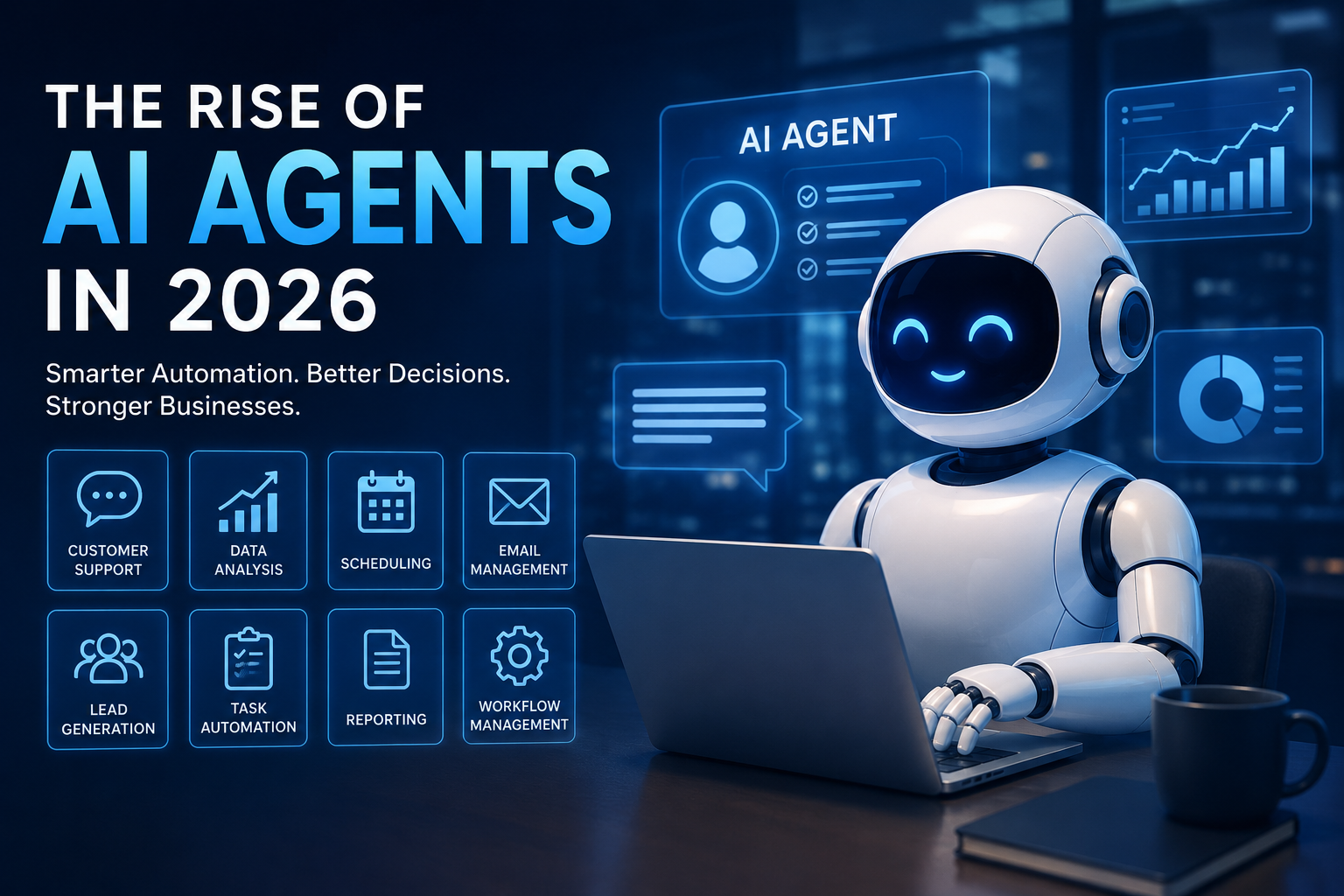
Artificial intelligence is evolving faster than most people expected, and in 2026, AI agents have become one of the biggest technology trends worldwide. Businesses are no longer satisfied with simple AI chatbots that only answer questions. They now want systems that can complete tasks, organize workflows, communicate with customers, and make decisions with very little human involvement.
Over the last year, companies of all sizes have started integrating AI agents into their daily operations. From online stores and startups to enterprise-level organizations, businesses are using AI automation agents to save time, improve productivity, and reduce repetitive work. This rapid growth is exactly why the future of AI agents has become one of the most discussed topics in the technology industry today.
What Are AI Agents?
AI agents are intelligent software systems designed to perform tasks autonomously. Unlike traditional AI tools that only respond to commands, modern autonomous AI agents can understand goals, gather information, plan actions, and complete multi-step tasks independently. This makes them far more advanced and practical for real business use, especially for growing digital platforms like alphainsider.co.uk that rely on smarter workflow management and automation.
The biggest reason AI agents are attracting attention in 2026 is their ability to work across multiple platforms at once. They can interact with emails, CRMs, scheduling tools, analytics platforms, and customer support systems without needing constant supervision. Because of this, businesses are beginning to treat AI agents like digital team members rather than ordinary software tools.
Why AI Agents Are Growing So Rapidly
The demand for AI agents for businesses has increased rapidly because companies want faster operations without dramatically increasing costs. Many businesses are struggling to manage repetitive tasks efficiently, especially in highly competitive online industries. AI automation agents help solve this problem by handling routine processes automatically.
Another major factor behind this growth is the improvement in AI technology itself. Modern AI systems understand human language far more naturally than earlier versions, making conversations and workflow management smoother. As a result, businesses now trust AI agents with more important tasks than ever before.
Main Reasons Businesses Are Adopting AI Agents
Companies across different industries are turning toward AI automation for several important reasons:
- Faster workflow management
- Reduced operational costs
- 24/7 customer support availability
- Better productivity for teams
- Improved response times
- Less repetitive manual work
These advantages are helping businesses stay competitive in a fast-moving digital environment. Companies that adopt AI agents early are often able to improve efficiency much faster than competitors still relying entirely on manual processes.
How AI Agents Are Transforming Businesses
The impact of autonomous AI agents is now visible across nearly every major industry. Businesses are using AI systems to automate repetitive work while also improving customer experiences. This combination of speed and efficiency is one of the biggest reasons AI agents are becoming essential in 2026.
Many organizations also see AI agents as long-term investments rather than short-term technology trends. Instead of replacing entire teams, most companies are using AI systems to support employees and improve workflow management. This balance between human skills and automation is shaping the future of modern workplaces.
AI Agents in Customer Service
Customer support has changed dramatically with the rise of AI agents. Modern AI systems can now answer questions, process requests, track orders, and manage customer conversations naturally without needing constant human involvement. Businesses are using these systems to provide faster and more reliable support around the clock.
Customers are also becoming more comfortable interacting with AI because conversations feel smoother and more human-like than before. In many cases, people do not even realize they are speaking with an AI system. This improvement in communication quality is helping businesses trust AI support tools more confidently.
Tasks AI Agents Commonly Handle
Automating these tasks allows teams to focus more on strategic planning and creative work instead of repetitive administrative responsibilities. This is one of the main reasons businesses are investing heavily in AI automation agents in 2026. Today’s AI agents for businesses are capable of managing many routine operations automatically:
- Appointment scheduling
- Customer support replies
- Email management
- Lead generation
- Workflow organization
- Data reporting
AI Agents in Marketing and Content Planning
Marketing departments are also rapidly adopting AI agents to improve efficiency and campaign performance. These systems can analyze customer behavior, track engagement patterns, and help businesses create more personalized marketing strategies. As competition increases online, brands are looking for smarter ways to connect with audiences, and websites like techcrunch.com frequently highlight how AI-driven marketing is reshaping digital engagement.
Content planning has become much faster with AI-powered support systems. Businesses now use AI agents to organize publishing schedules, monitor SEO performance, and identify trending topics. While human creativity still remains important, AI tools are helping teams manage workloads more efficiently than before.
How AI Improves Marketing Workflows
These tools help businesses make faster decisions based on real-time data. As marketing continues becoming more competitive, companies are relying on AI automation agents to stay ahead in digital spaces. AI agents are now helping marketers automate several time-consuming tasks:
- Social media scheduling
- Audience behavior analysis
- SEO keyword tracking
- Campaign performance monitoring
- Content planning assistance
- Automated customer engagement
Latest Trends in AI Agents in 2026
The AI industry is changing rapidly, and several major trends are shaping the future of AI agents this year. Businesses are no longer looking for simple automation systems. Instead, they want intelligent AI tools capable of handling more advanced operations independently.
One of the biggest trends in 2026 is the rise of specialized AI agents built for specific industries. Companies are moving away from general-purpose systems and adopting AI tools designed specifically for healthcare, finance, retail, legal services, and customer support.
Biggest AI Agent Trends This Year
Several important developments are driving the growth of AI agents worldwide:
- Industry-specific AI systems
- More advanced voice AI technology
- Smarter workflow automation
- Multi-platform AI integration
- Personalized AI assistants
- Faster enterprise AI adoption
These trends show that AI agents are becoming more practical and business-focused rather than experimental technologies. Companies now see AI automation as an essential part of long-term growth strategies.
Real-World Examples of AI Agents
Businesses around the world are already using AI agents in highly practical ways. eCommerce companies rely on AI systems to recommend products, answer customer questions, and monitor shopping trends. This helps improve customer experiences while increasing efficiency behind the scenes.
Startups and smaller businesses are also benefiting heavily from AI automation agents. Teams with limited staff can now manage larger workloads because AI systems handle many repetitive administrative tasks automatically. This allows smaller companies to compete more effectively with larger organizations.
Industries Using AI Agents the Most
Each industry is using AI differently, but the overall goal remains the same: improving efficiency while reducing manual workload. This widespread adoption is one of the clearest signs that AI agents are becoming a normal part of modern business operations. AI agents are becoming increasingly popular across multiple industries, including:
- eCommerce and online retail
- Healthcare and medical support
- Digital marketing agencies
- Finance and banking
- Customer service companies
- Real estate businesses
Challenges Businesses Still Face
Despite the excitement surrounding AI agents, businesses still face several important challenges. Accuracy remains one of the biggest concerns because AI systems can occasionally misunderstand instructions or generate incorrect outputs. For this reason, human oversight is still extremely important in many industries.
Data privacy and security are also major topics in 2026. Since AI agents often access customer information and internal business systems, companies must invest heavily in cybersecurity. Businesses want the benefits of automation, but they also need to protect sensitive data from potential risks.
Concerns About AI Agents
While AI automation offers many advantages, experts still discuss several important concerns:
- Data privacy risks
- AI-generated inaccuracies
- Overdependence on automation
- Security vulnerabilities
- Workplace adaptation challenges
- Ethical concerns around AI decisions
These issues are encouraging businesses to adopt AI carefully rather than rushing implementation without proper planning. Responsible AI usage is becoming one of the most important discussions in the technology world today.
The Future of AI Agents
The future of AI agents looks incredibly promising as technology continues improving. Experts believe AI systems will eventually become standard business tools in the same way email and cloud software became essential over time. Companies that adapt early may gain significant advantages in productivity and efficiency.
Over the next few years, autonomous AI agents are expected to become smarter, faster, and more independent. Businesses will likely use AI systems for increasingly complex workflows, allowing employees to focus more on creativity, strategy, and leadership rather than repetitive operational work.
What Experts Predict for the Future
Technology analysts believe the next phase of AI development may include:
- Fully autonomous workflow systems
- AI-powered digital assistants for employees
- More advanced voice AI interactions
- Smarter decision-making automation
- Human and AI collaborative workspaces
- Wider AI adoption across industries
As these developments continue, AI agents may become one of the most important technologies shaping modern businesses. The companies that understand and adapt to this shift early are likely to benefit the most in the years ahead.
Frequently Asked Questions
As AI agents continue gaining popularity in 2026, more businesses and everyday users are becoming curious about how this technology actually works. From automation and productivity to security and future job impacts, people have many important questions about the role AI agents will play in modern industries. Below are some of the most commonly asked questions related to AI agents, AI automation systems, and the future of intelligent business technology.
What are AI agents and how do they work?
AI agents are intelligent software systems that can perform tasks automatically with minimal human involvement. Unlike traditional chatbots, they can understand goals, make decisions, gather information, and complete multi-step tasks independently. In 2026, businesses are using AI agents to manage workflows, customer support, scheduling, and many other operations more efficiently.
Why are AI agents becoming so popular in 2026?
The rise of AI agents is mainly driven by the growing demand for automation and faster business operations. Companies want to reduce repetitive manual work while improving productivity and customer experience. Modern AI technology has also become more advanced, allowing AI agents to communicate naturally and handle complex tasks more accurately than before.
Can AI agents replace human workers completely?
AI agents can automate repetitive and time-consuming tasks, but they cannot fully replace human creativity, leadership, and emotional intelligence. Most businesses use AI systems to support employees rather than remove them entirely. In many industries, AI is helping teams work faster while humans continue focusing on strategic and creative responsibilities.
Which industries are using AI agents the most?
AI agents are widely used in industries like eCommerce, healthcare, finance, digital marketing, and customer service. Businesses use them for tasks such as customer communication, appointment scheduling, workflow automation, and data analysis. Their flexibility makes them useful for both small startups and large enterprise organizations.
What is the future of AI agents?
The future of AI agents looks extremely promising as technology continues improving rapidly. Experts believe businesses will increasingly rely on autonomous AI agents for daily operations and workflow management. Over the next few years, AI systems are expected to become smarter, more personalized, and more deeply integrated into workplaces worldwide.